
As formats like Google AI Overview and ChatGPT become a more common way that people gather information, it has begun to shift the way we think about and approach the paid media landscape. There will be new ad formats, new placements, and a general shift in how people use a tool like ChatGPT compared to how they historically used a search engine like Google.
In order to discuss all the nuances AI has begun to introduce and replace in the search landscape, let’s begin with a look at a more traditional understanding of search queries. Queries can commonly be categorized into four categories: informational, commercial, transactional, and navigational.
The first two search categories, informational and commercial, have already become common with AI Overviews on Google, shifting how and where people gather information.
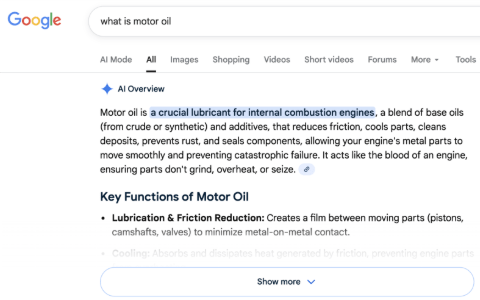
Informational: Shows an intent to learn, Ex. “What Is Motor Oil”
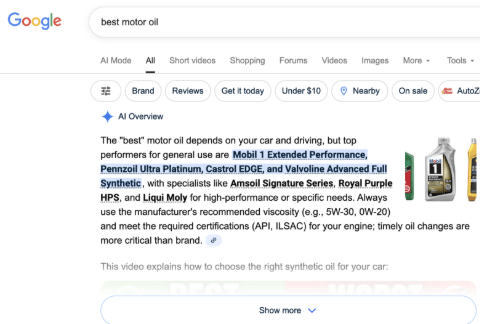
Commercial: Research of a product or service, Ex. “Best Motor Oil”
The remaining two search categories, navigational and transactional, have not shown as much of a presence in AI outputs yet. That will likely shift, but currently the experience someone sees is a bit more direct.
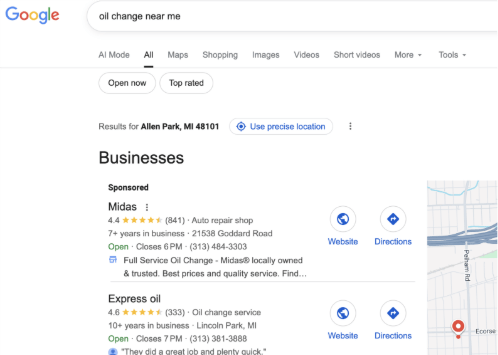
Navigational: Find a specific location or website page, Ex. “Oil Change Near Me”
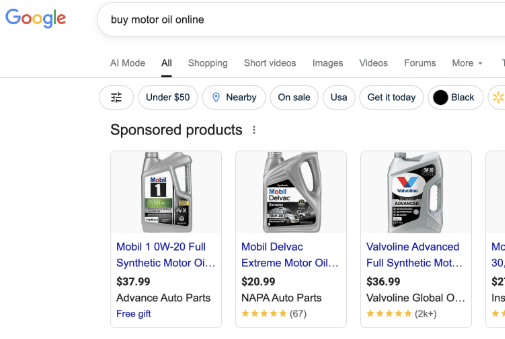
Transactional: Complete an action, “Buy Motor Oil Online”
Now that we’ve discussed the variety of search categories, it’s easy to see how seamless and common AI features like AI Overviews are becoming, it can easily save you from clicking through to multiple sites if you were just looking for a basic list of something like “best motor oil”. You can quickly gather the information you need within the AI Overview. This can save time for the consumer, but as a brand that relies on this traffic for a potential purchase, it can have a negative effect.
This has kicked off a significant change in how Google approaches a core part of its business with Google Ads. Now ads are eligible to serve directly within the AI Overview, which for us as advertisers, has given us the opportunity to reach customers who are even closer to converting. Historically, someone would build search campaigns around keywords like “best motor oil” and potentially see a healthy conversion rate.
Today, with people becoming more comfortable with using AI Overviews, AI Mode, or a chatbot like ChatGPT and having a more conversational approach to their queries, we can connect with an in-market customer at the right moment. With these tools, a query could easily look like this, “I need motor oil for my 2022 Chevy Silverado what should I get?” or “Why is my truck’s engine making a knocking noise?”. Here it is easy to see that there is more urgency showing they are likely in-market, compared to someone just searching for “best motor oil.”
This shift has changed how we think about our “traditional” paid search campaigns. It’s impossible to predict or manage every question someone might ask one of these tools and use those as keywords in a campaign. This has put a greater emphasis on adopting broad match keywords so we can maintain comprehensive coverage when these varied searches happen in real time. In addition to keywords, the smart bidding function allows Google Ads to adjust bids in real time based on signals for which action is most likely to convert. One further piece to monitor is creative, making sure that the copy is informational and relevant to your products or services, making it applicable to the varied list of searches it will now be eligible to appear alongside.
Paid search ads have always been one of the most relevant forms of advertising because you can reach someone who is actively searching for something to purchase. This is only the beginning, but we are quickly seeing how these AI tools can better analyze user intent and match relevant ads to highly specific queries. With the right campaign structure around areas like keywords and ad copy, it will help to make sure the campaigns are setup for success as these features become more commonplace.